

Senior Product Manager, Infrastructure Engineering, Cloudflare;
Adjunct Lecturer, Parsons School of Design.
By Lai Yi Ohlsen, a researcher based in New York City. She is a Senior Product Manager of performance and network quality at Cloudflare and a part-time lecturer at the New School in the Parsons Design & Technology program. Previously she was Director and Research and Data Lead at Measurement Lab and Technical Program Manager at eQualit.ie. She is currently a member of eQualitie’s Board and Quad9’s advisory PEHR council. You can read more of her work on Internet Index, an accumulation of research shaped around the Internet and its associated infrastructures.
What We Talk About When We Talk About Splintering
The term “Splinternet” suggests that there was a “whole” Internet to begin with – a singular entity capable of being fractured. An Internet to splinter. If we assume this to be true, that there is a state that does or has or could exist where the Internet is a single, unified entity, the next question becomes what was or is this unbroken version of the Internet? When did it exist or has it ever existed? And how would we describe it – what does it mean for the Internet to be whole?
One of the earliest mentions in popular media of the term “splinternet” came from the libertarian advocate Clyde Wayne Crews who published for Forbes in 2001 about the positive potential for “parallel Internets.” In his telling, the Splinternet is the way out of what he and others call “the tragedy of the commons.” His recommendation: “Take the Internet private and split it up.” The article references the usual libertarian touch points such as private property and eliminating the monopoly, but in follow up comments to Wired, he also positions it in terms of the social. “Do people want to be connected to everyone? I don’t think so. […] Fundamentally, people want to be connected to other people like them.” To Crews at the time the Splinternet was the anti-commons – the private park with a gate code, while the Internet is a dirty public square. Splinternet good, Internet bad. But to his likely disappointment, as the term has become popularized, it has become much more known for the inverse: Splinternet bad, Internet good.
The Internet Society defines a splinternet as “the idea that the open, globally connected Internet we all use splinters into a collection of fragmented networks controlled by governments or corporations” and routinely leads calls against Internet fragmentation. Such advocacy strongly signals that the Splinternet is something to be avoided at all costs, even going so far as to argue that a shattered Internet is not the Internet at all—that the Splinternet is its existential opposite.
But either way, the model appears to be, at least conversationally consistent – whether you’re Crews or the Internet Society – the way we talk about the Splinternet consistently positions it as the anti-Internet. To be splintered is to be antithetical to the original purpose/architecture/intent of the Internet.
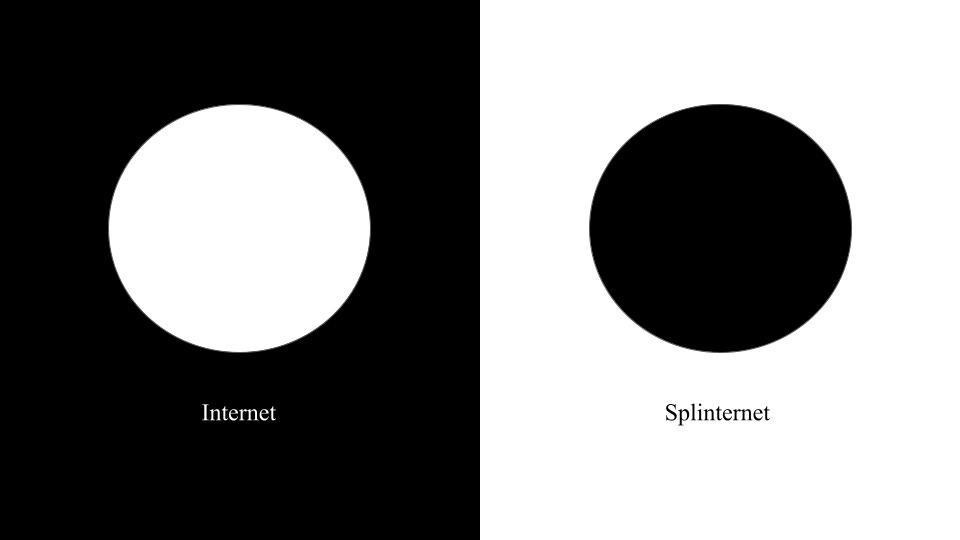
The concept of Splinternet operates as a conversational proxy for the definitional bounds of the Internet. Through the prism of fragmentation we produce inverted manifestos for what we think the Internet is, was, or ought to be. The concept of the gothic double comes to mind – perhaps we might think of the Splinternet as the Mr. Hyde to our Dr. Jekyll. But instead of just double, the Splinternet references fragmentation, or balkanization, of the many-to-many-th degree. Within the shadow twin of the Internet can be multiple internets, a nesting doll of networks of networks, each of which constitute an internet which is not the Internet.
However, the conversational dichotomy of the Splinternet as the anti-Internet has made the term quite ambiguous and sort of a catch all for fissures of multiple, indiscriminate kinds such as the ones listed here. This wide expanse and variety makes it difficult to define what it is we’re actually trying to prevent.
One of the most popular uses of the Splinternet is when referencing network outages, often due to infrastructural fender-benders, government-mandated blocking of content via techniques such as packet interception, throttling or in some cases full-scale shutdowns. The term is also often used to reference fractures in approaches to governance, such as data-localization mandates to contain information within geographical borders or initiatives to replace multi-stakeholder institutions with state-centric or private control.
Perhaps the most visceral association with the word is when referencing not the Internet itself but the user experience of the web. Many of us with casual acceptance discuss content shown to us by “our” algorithms, signifying that my Internet is different from your Internet. ”Internet” here refers to not the multiple layers of infrastructure and protocols and governance that facilitate the transmission of my dog videos vs. your cat videos, but the platforms which feed themselves from the data we generate when we loiter in their privatized public square. Indeed, much of what Crews’ initially imagined for parallel Internets has come to fruition through the centralization of services. Geoff Huston, chief scientist at APNIC, describes centrality and fragmentation as “diametrically opposed perils” regarding the risks they pose to the open Internet…though it’s also curious how they reinforce one another. Most people’s perception of the Internet is dominated by the same handful of tech companies which paradoxically fragments our experience further – not by consensus-driven commons, but by market-driven segmentation.
But throughout the 2000s and early 2010s, collapsing all of these different uses into the same bucket of Splinternet or anti-Internet was a seemingly straightforward technique, at least for the production of the concept. Until recently, initiatives such as Russia’s RuNet, China’s Great Firewall and Iran’s National Information Network have fallen neatly on the side of “splintered” and much of the Western world fell, at least in the Western World’s telling of it, fell neatly within “the Internet”. But as the thematic for Splintercon Paris has pointed out, shifts over the past decade in Internet governance and the rise of so-called digital sovereignty initiatives have complicated these categories.
The thematic asks: “How can governments balance protectionism without splintering the digital commons? Do ambitions for sovereignty lay the groundwork for isolation?” In reference to the EU’s pursuit of digital sovereignty as “both a regulatory and technical project, driven in Section by a desire for independence from American and Chinese control over cyberspace,” and the “growing number of states, including Australia, Brazil, Canada, India, and South Africa” who are also considering their own approaches to “strengthen domestic industries and secure their networks”, the organizers have asked us to consider, “Are these models complementary, or do they reinforce competing visions of the internet?”
What these national initiatives, and the provocations surrounding them, signal is that the evolution of the Internet has complicated the popular dichotomy of “Splinternet bad, Internet good,” or more generally the concept of the Splinternet as the anti-Internet. What happens when we begin to see ourselves in the mirror of our gothic double?
Is Brazil’s focus on large-scale state-supported Internet Exchange Points different from Iran’s focus on nationalized Internet infrastructure? Are the EU’s “digital sovereignty” and routing resilience proposals risking the vision of an open Internet that it has historically been a proponent of? While the knee jerk reaction is to say no, if nothing else because of the interests and principles of their implementers, we need more language and definition to model and reason about these approaches.
Categorizing the Splinternet
By Approach
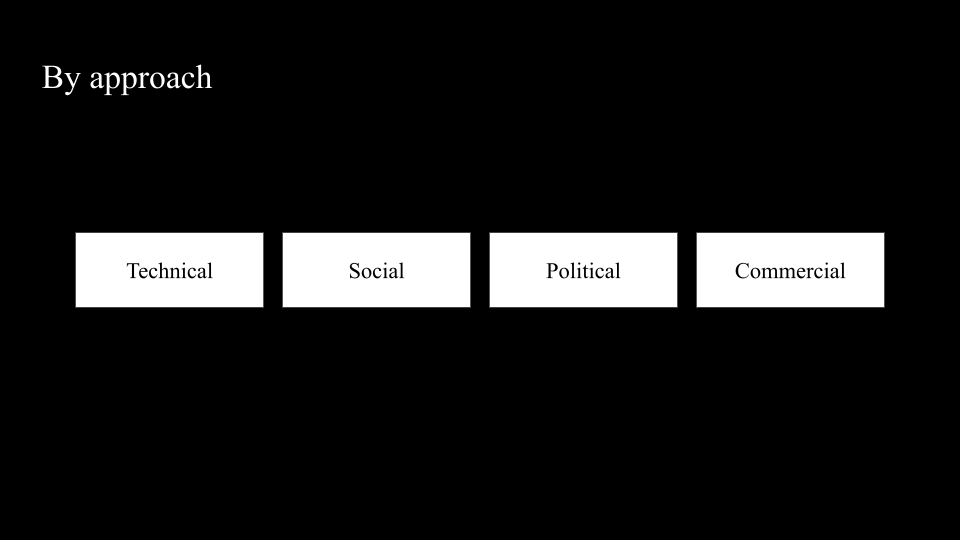
One starting proposal might be to sort them by their approach such as, technical, social, political, commercial – but most examples will quickly reveal that the barriers between these divisions are porous. For example, DNS court orders which mandate ISPs and DNS resolvers to effectively block content by returning incorrect DNS answers are technically technical interventions – but describing them as such doesn’t properly describe the scope of their impact. Many cases such as these merge legal authority, commercial interests and technical infrastructure and make it difficult to describe them in any one mode of fragmentation.
By Layer
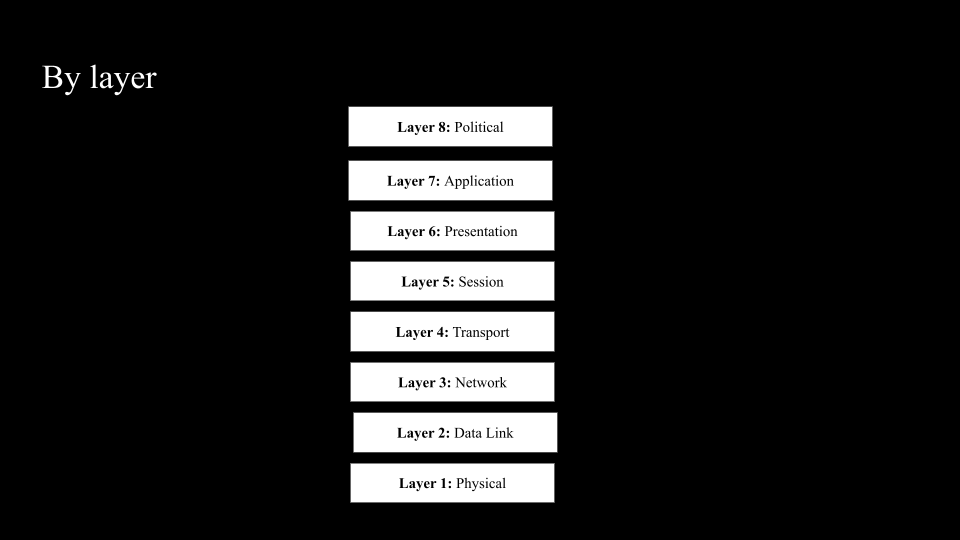
Another proposal might be to categorize splintering techniques by where they operate in the Internet stack. For intsance, making content inaccessible via TLS throttling can be described as a Layer 4 technique while changes in Internet governance or legal regulation refer to Layer 8.
By Place In the Path
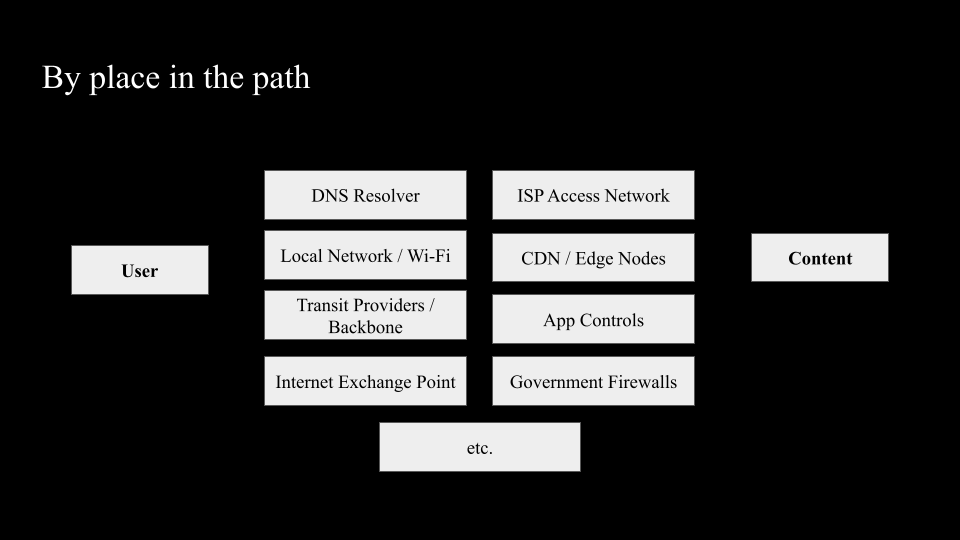
Another approach consists in describing interventions by localizing their interactions with a packet’s path from user to content and back, from a user’s device to their eyeball ISP to DNS to CDNs or transit networks and so on. This is a more fine-grained approach, but in the ever evolving Internet landscape it’s tricky to say what’s a “typical” scenario of a user’s experience accessing content is – defining standards and expectations around what a splintered vs. un-splintered path might be challenging when the patterns of those paths change on the order of milliseconds.
Plus, neither of these categorization approaches do much for describing the nuance of intention – part of what we need more articulation around is how an approach to sovereignty can support democratic and open principles vs. authoritarian ones. Their impact and location on the technical stack can only do so much. Indeed, the same way engineers, hackers and researchers will often scoff at the degree of accuracy and precision that scholars of the humanities leave out of their writings on the Internet, the same can be said for the way technical-forward interpretations lump together the machinations of politics and the economy.
By Motivating Principles
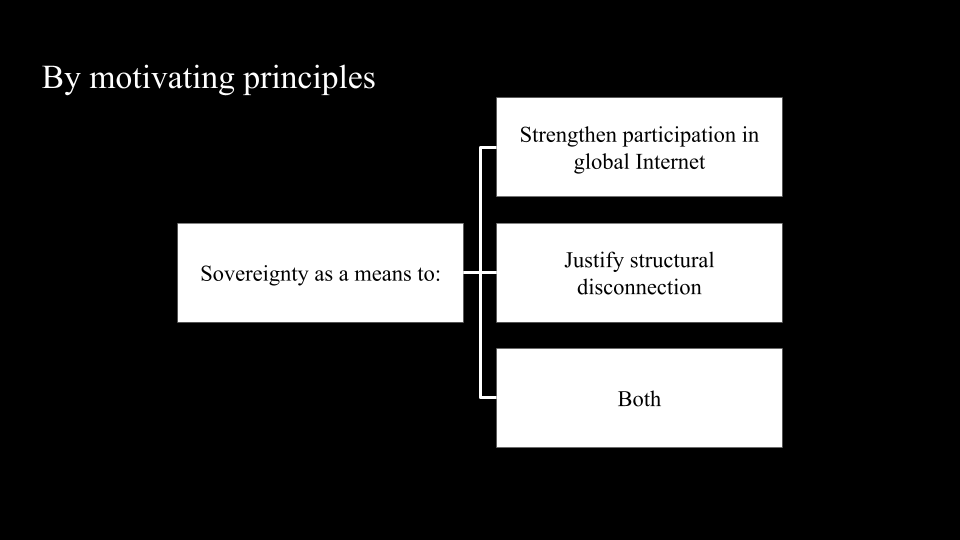
We might also consider sorting the Splinternet and different approaches by their stated motivating principles, in other words, what vision of the Internet are they trying to create? Do they present sovereignty as a proactive measure to strengthen participation in the global Internet or as rationale for structural disconnection? Many recent examples of digital sovereignty movements make appeals to both the “good” Splinternet and “bad” Splinternet by emphasizing the need for autonomy and control while still pledging their commitment to the global project of interconnection. This kind of rhetoric suggests that we can and should create a third category which, in reference to the thematic, seek to provide complementary models instead of competing visions.
But is this possible in practice? It’s all well and good to say this is what you want but it sounds a bit like having your cake and eating it too. How will we know that these efforts are accomplishing the balance they say they will?
By Measured Impact
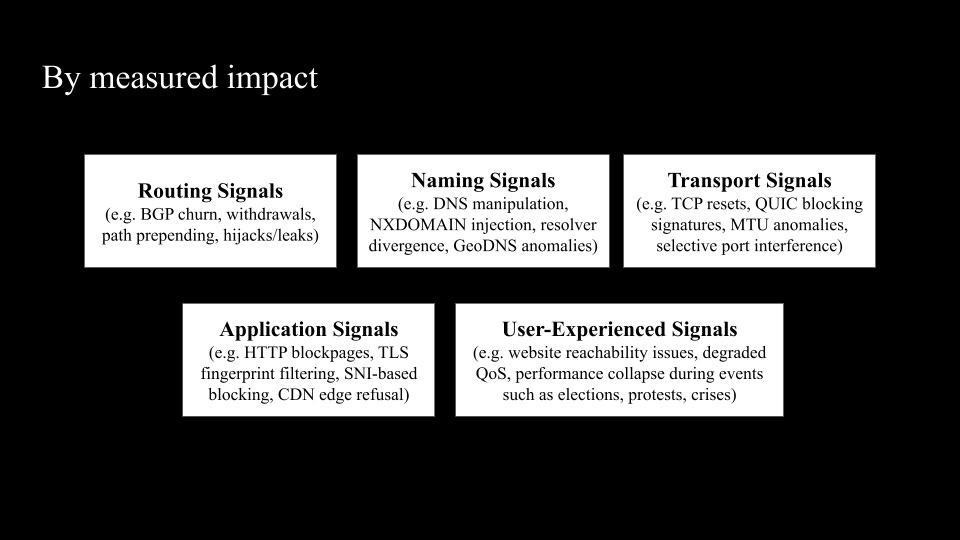
Perhaps a more practical way to approach categorization is by utilizing data-driven evidence and asking what impact can we quantify that these techniques have on the Internet? If actors say they are motivated by a global, interoperable Internet, can we find evidence of that in the data? Can we measure if the Internet is more or less fragmented as a result of a given nation’s approach? Signals from routing, naming, transport, application and user-experience measurements can help distinguish fact from fiction, impact from rhetoric.
The French research lab GEODE’s analysis of BGP data, which examines the gap between the architecture of connectivity and publicly stated levels of political cooperation, shows how socio-political analysis combined with the study of technical artifacts can provide a framework for more effectively contextualizing and categorizing the Splinternet. However, this kind of contextualization is extremely difficult, particularly at scale. Doug Madory has written extensively about the risks and pitfalls of over-indexing on or oversimplifying data, especially when attempting to attribute activities associated with Internet fragmentation. An enormous amount of contextual knowledge is required to determine whether or not a cable cut in the Red Sea was intentional or not, or whether networks disconnecting from one another are the result of competing economic interests or the result of politically motivated government interventions. Even with that context, however, such determinations are often difficult to “prove” at least in the legal sense of the word.
Many fragmentation activities can look identical in the data and if we attempt to categorize them by their motivation and the actors enabling them, attribution becomes blurry – specially for activities that unfold over longer timescales than discrete “events” such as outages or shutdowns. For example in Cuba, the practice of network interference during protests is common; however there is also much reporting of the poor network quality, which can make the low baseline of Internet quality hard to distinguish from that of a throttling event.
While categorizing the Splinternet by its impact using data-driven techniques is compelling, it poses unique challenges which might hinder its scalability.
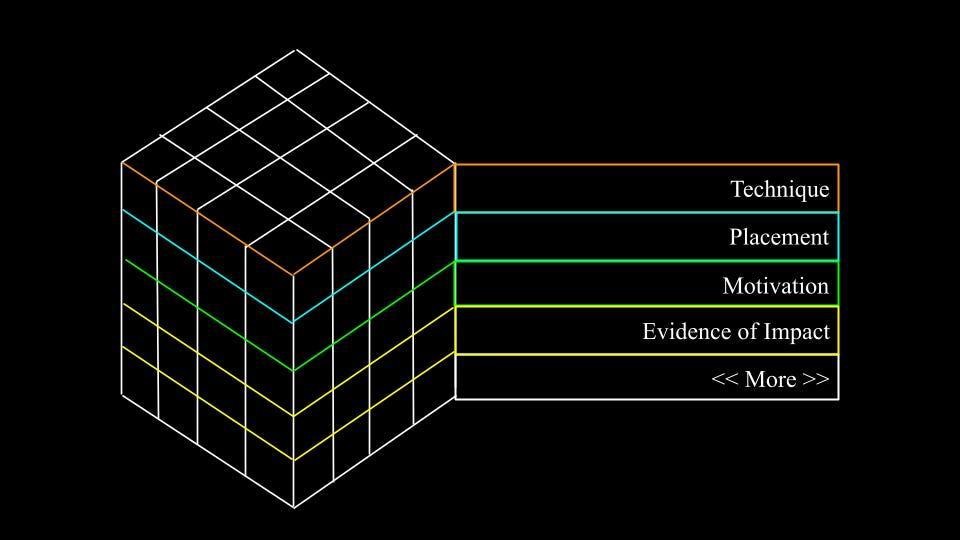
With all of these potential approaches to categorization and their potential pitfalls in mind, we probably need some hybrid, matrixed approach which considers technique, placement, motivation and evidence of impact and likely more vectors I haven’t covered here. No one approach will cover all of the dimensions but perhaps can provide enough shape to define these models emerging between the space of “good” and “bad”, Internet vs. Splinternet.
That said, a question arises: do categories really matter if the end result is the same? Does it matter if the inability to connect and perform basic tasks online is due to geopolitical or economic interests? Does it matter if an outage is due to an infrastructural failure or a politically motivated action?
On the one hand, yes, if only because they hold different parties responsible and suggest a different menu of solutions – but in terms of defining the Splinternet, if an individual or community’s access to content is restricted, then perhaps that’s the only definition of the Splinternet that we need. Is the Internet facilitating global, end to end communication or is it not? And what if the answer is no?
The Internet Has Always Been Splintered
If the Internet is a “unified, open, global network that everyone in the world is able to access and benefit from” I would argue that such a state has never been. That is, the Internet has always been the Splinternet and vice versa and that the blurry boundaries of these modes is nothing new. Perhaps there is no such thing as the Internet and the Splinternet, but only one entity that is a combination of the two.
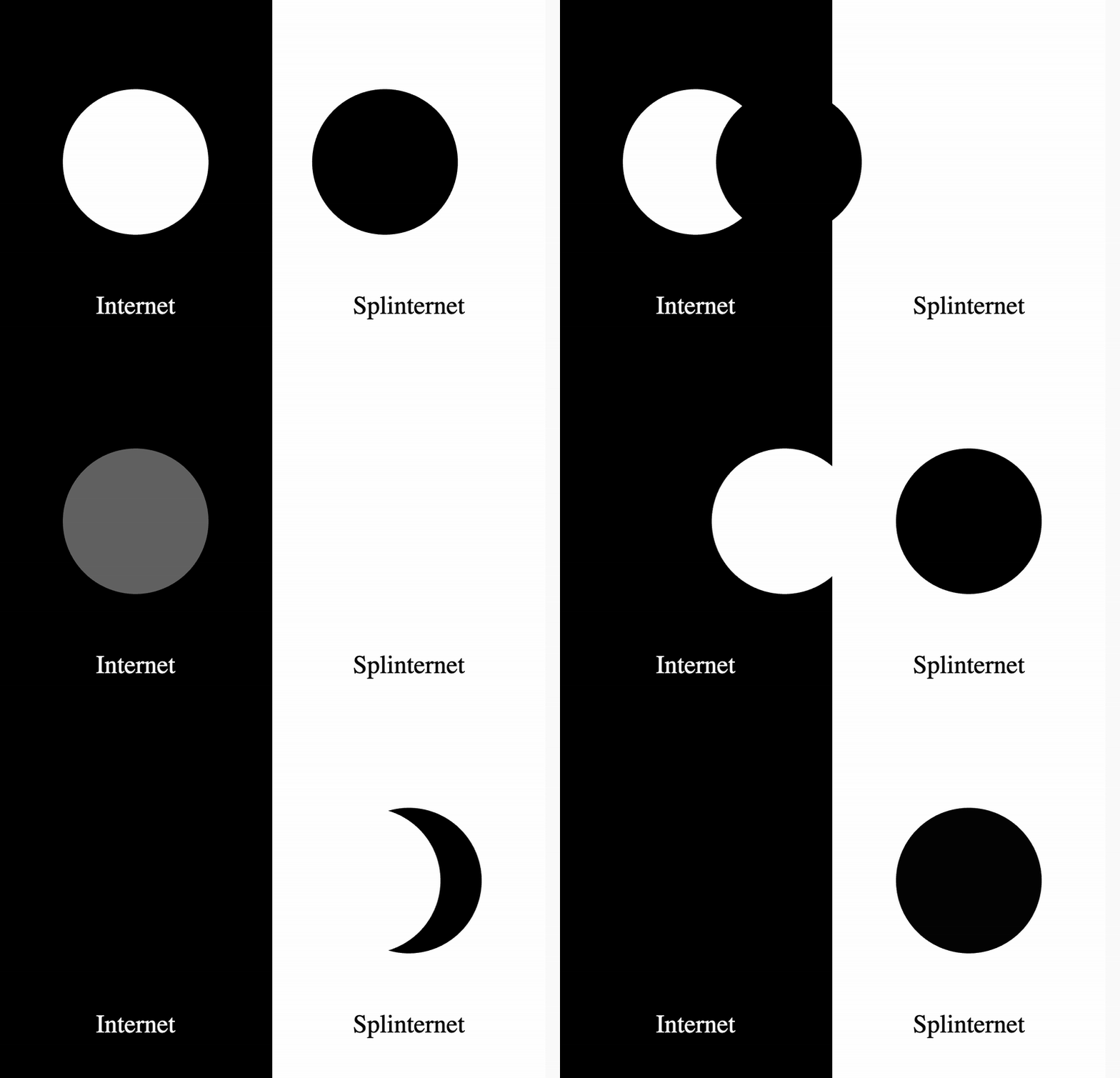
For starters, an estimated 30% of people globally do not have access to the Internet, and so in the most basic sense the Internet is fragmented in so far as some people can access it and some people cannot. This is a predictable circumstance given the uneven “rollout” of the Internet which has always been molded by economic and political incentives – but its result is a radically bumpy texture across the surface area of the network. Digital culture and literacy vary depending on when individuals and communities come online and from a technical perspective, so does quality of experience. Even once you’re connected, your experience can vary dramatically depending on where you connect from. For example, connecting from a rural area via satellite vs. a fiber-to-the-home connection in a big city are two different experiences in terms of network quality. Similarly, a user’s path to content is often much less direct outside of North America and Europe, and yet all of these experiences are currently summed up under the umbrella of “the Internet”. These disparities are inevitable to a degree. It would have been impossible to implement a global Internet in a uniform fashion in one go, much like it would be impossible to build a city in one day.
The Internet is not so different from a city; they are, after all, both fundamentally infrastructures and as the writer Adam Rothstein has pointed out, “Infrastructure’s power, combined with its lack of visibility, is the stuff of our society’s physical unconscious”. In a city, some neighborhoods have more potholes than others, some have more access to grocery stores – what it means to live in New York City can vary block to block. Why? The answers are almost always not solely technical. Similarly, the Internet is as situated within a political economy motivated by commercial and political and public interests as much as any other infrastructure and because of this the Internet is inherently splintered in terms of access and experience. Since its creation, being connected to the Internet has never meant that you have the same quality of experience as everyone else. But despite these discontinuities, cities and networks are bound together by common principles, shared values and use of common resources. For the Internet, this is the TCP/IP stack, the use of which has become so expected, that we often abstract it away as an assumption. To be connected to “the Internet” is to use Internet protocol. But it wasn’t always so, or at least it wasn’t always a given that TCP/IP would be how we would globally connect.
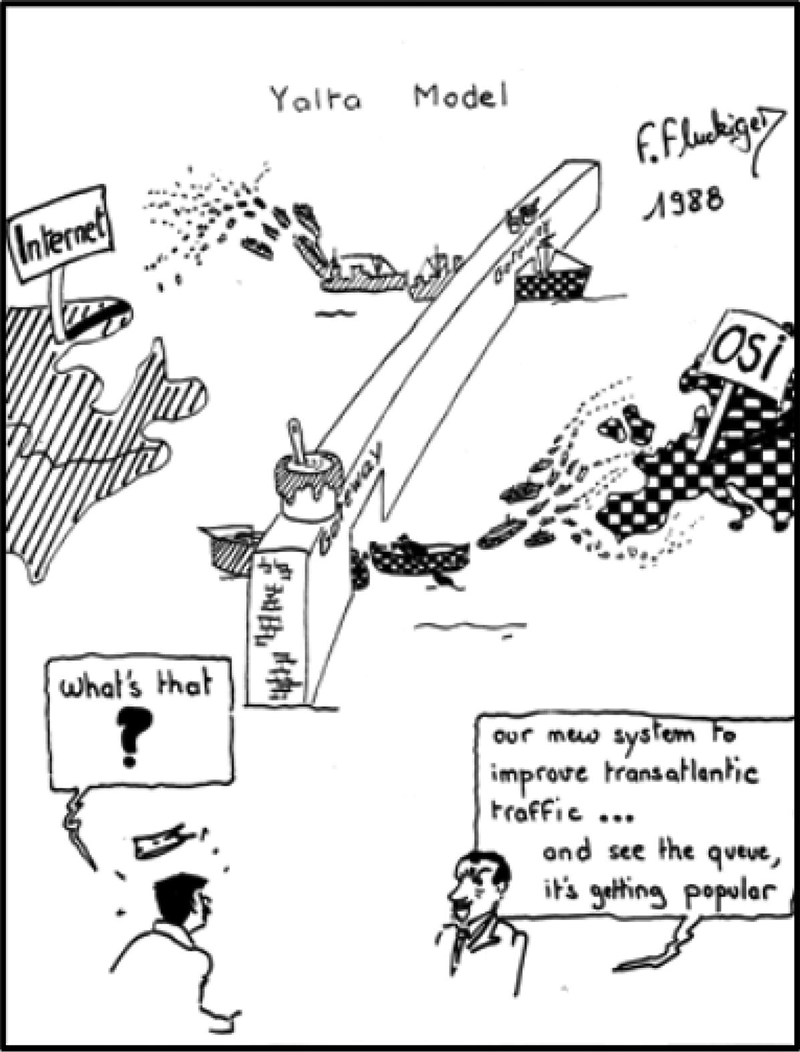
François Flückiger (1988)
The so-called Protocol Wars showed that “some people foresaw a division between world technologies: Internet in the United States, OSI in Europe.” Whether or not what we consider “the Internet” today would be fundamentally different we had chosen X.25 is a very fun question, but the premise of the question suggests that the Internet, as in the global end to end network that runs over TCP/IP was not inevitable, and could have been written to operate more than one way. Such precedent suggests that the vision of the Internet, not in terms of TCP/IP, but in terms of how to globally connect, was fragmented from the start.
When we look at the transitions between the protocols that we’ve progressively stacked on top and below TCP/IP, such as adoption of DNNSEC, moving from IPv4 to IPv6 or adoption of RPKI, these moves have often been bumpy and staggered as well. You get a sense of Tarzan swinging from vine to vine, loosely threading a connective tissue through a fragile ecosystem that could and might break at any time – but also, curiously hasn’t, or at least in a way that has prompted splinter-y speculation. Indeed, the concept of the Splinternet is curiously reserved for only some kinds of fragmentation, despite always being part of the Internet’s story.
If we accept that the Internet has always been fragmented, then the project of defining the Splinternet can become less about defining an “anti-Internet” but parsing the limits of the Internet’s own fragmentation. The Internet was created in a state of splinter and has continued to be splintered but how splintered are we willing to let it become, and in what ways?
Let’s think of the Internet as a glacier: all of the ways it can be fragmented are tiny taps on top of it which create cracks. If the Internet has always been fragmented and these taps are just part of its natural evolution, then the question is – what kinds of cracks will make the glacier break apart safely and perhaps most importantly, which cracks will result in shapes that can be put back together again?

Calling back to the “diametrically opposed perils” of centrality and fragmentation, perhaps the Internet, in its continuously fragmented state, is situated on a spectrum between them, sliding back and forth depending on the decisions of the many actors which enact their principles and design decisions upon it.
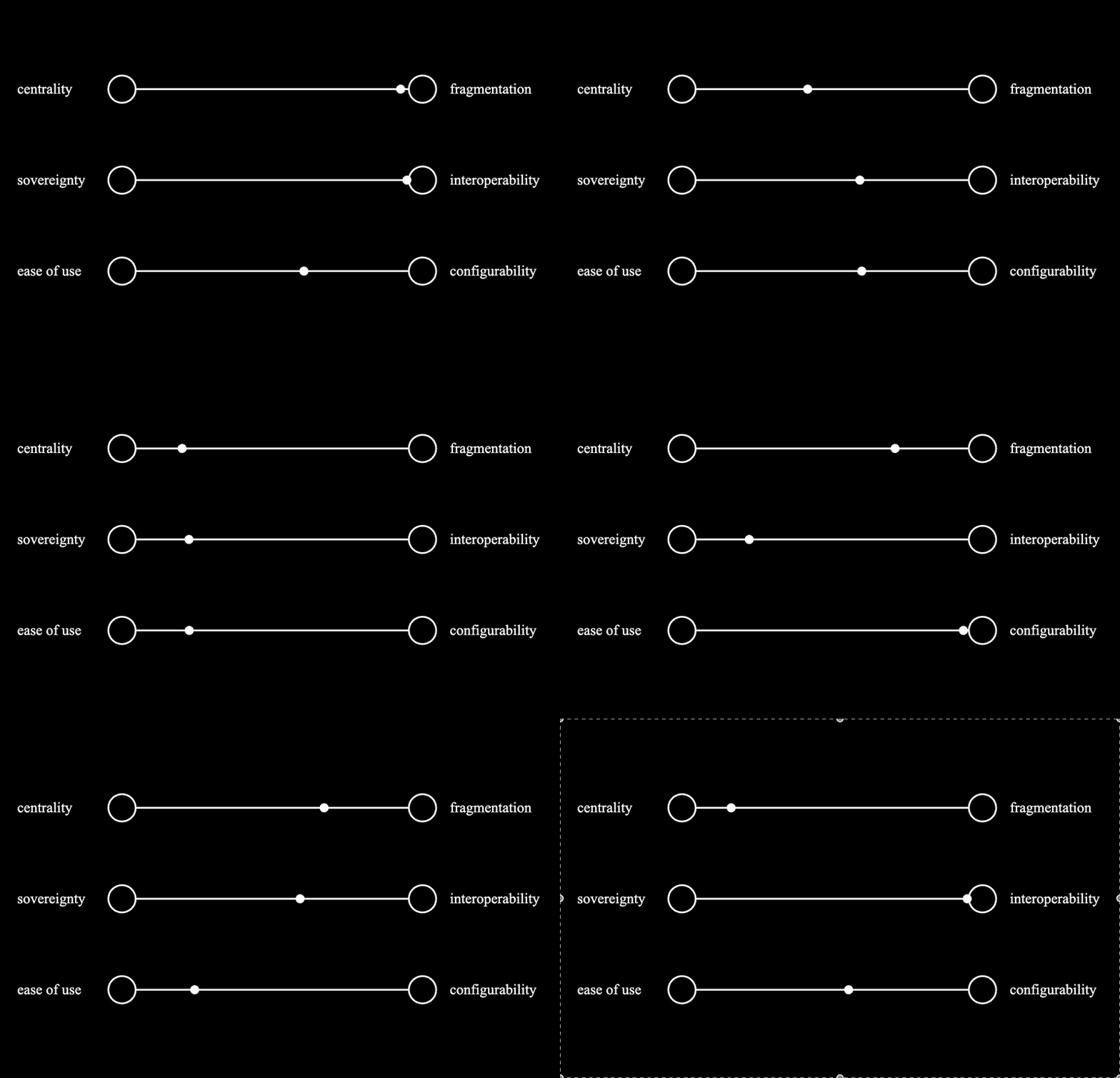
In fact, every design decision of the Internet is likely situated between two ends of a spectrum, such as sovereignty and interoperability, privacy and transparency, ease of use and custom configuration.
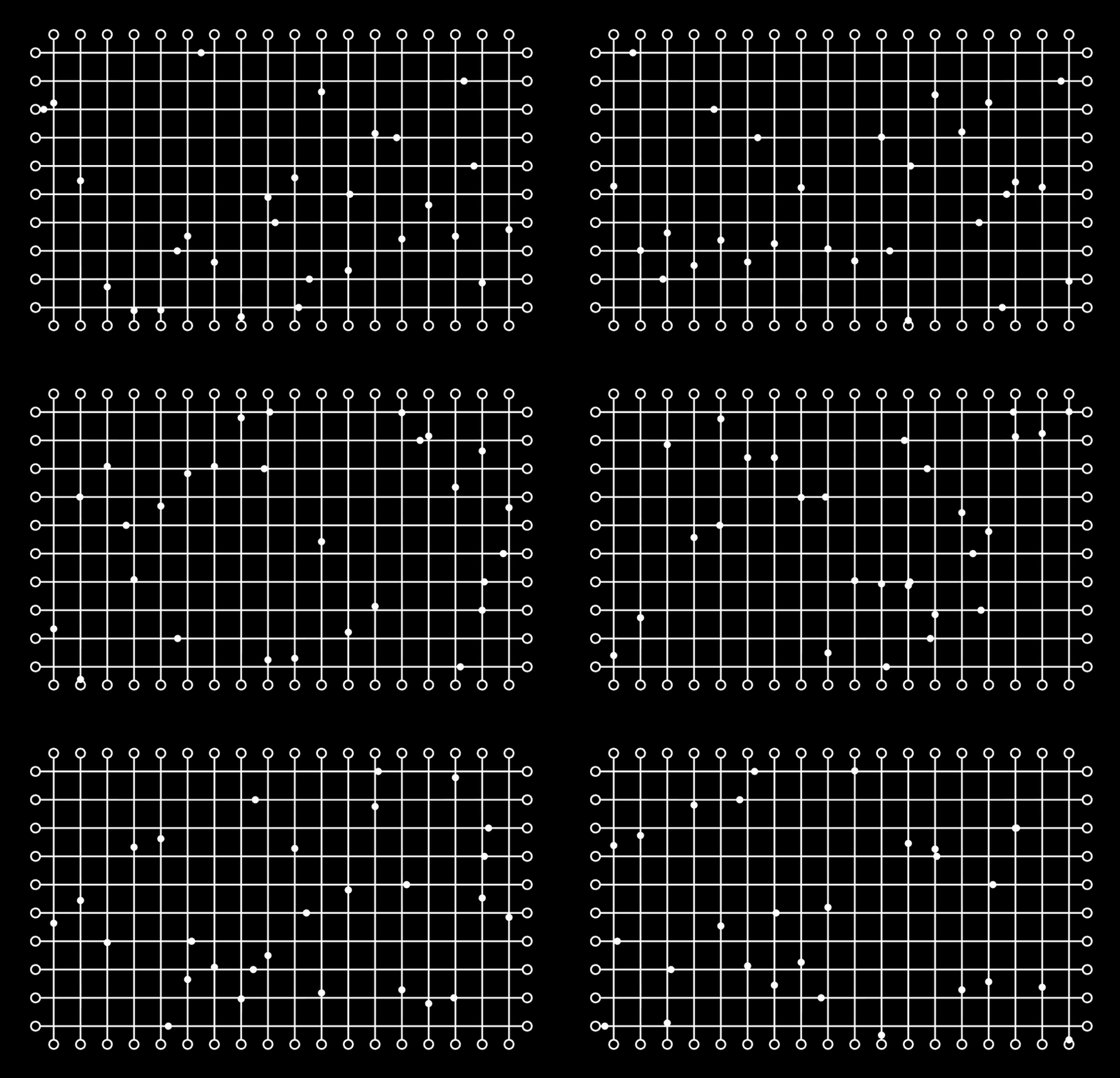
One can imagine placing these tens or hundreds or thousands of sliders on top of one another into a multi-dimensional matrix that perhaps resembles the network of the Internet itself.

Perhaps the definition of Internet is not a “whole” entity that exists on one side, fragmentation or another, but one that is able to traverse between the extremes of these tradeoffs with relative ease. The Splinternet might then be less about the degree to which the Internet is fragmented but the degree to which it’s stuck in one particular state of fragmentation, or in other words, one particular setting of the sliders. The Splinternet might then be less about the degree to which the Internet is fragmented but the degree to which it’s stuck in one particular state of fragmentation, or in other words, one particular setting of the sliders. I propose that the Splinternet is not the anti-internet but the static Internet. The Internet which cannot evolve and repair itself from fragmentation as it inevitably occurs.