
Section 2
Chapter 1
Perceiving Russian splinternet: 2025 trends through community sourced data
Digital Helpline NaSvyazi has been collecting testimonies of shutdowns since 2024 as part of their project Ru Net Monitor. At SplinterCon Paris they presented the 2025 Runet Restrictions Review, the first report which focuses specifically on shutdowns in Russia which highlights the growing fragmentation of the RuNet. We wouldn’t exaggerate if we call 2025 the Year of Shutdowns of Runet.
Indeed, the data from Runet Monitor for 2025 shows 12026 documented shutdowns just in one year, with major regions like Nizhny Novgorod and Moscow experiencing repeated disruptions. By mid-2025, mobile internet shutdowns became a normalized part of the government’s response to perceived threats. Restrictions are increasing over time, and particularly intensify around holidays like Victory Day and Russia Day.
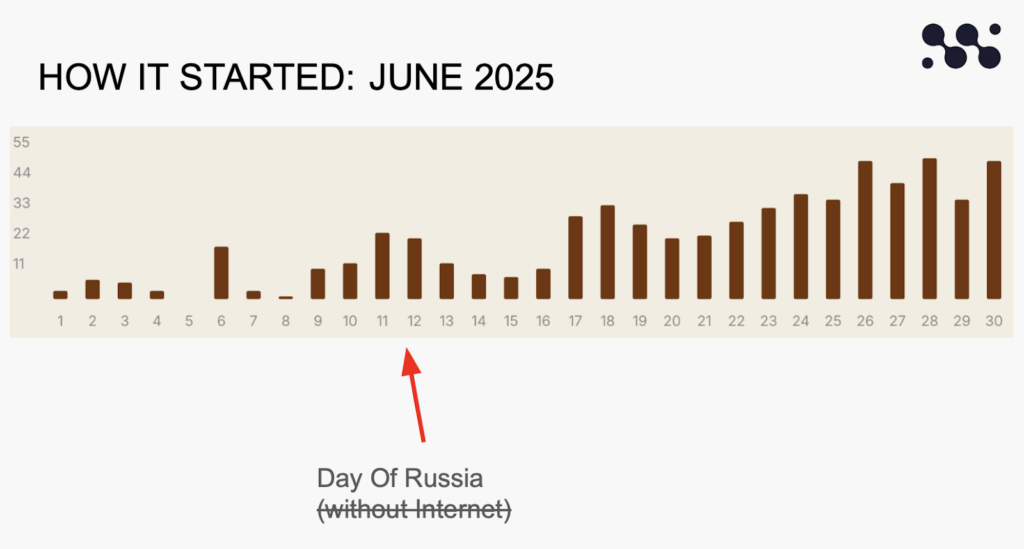
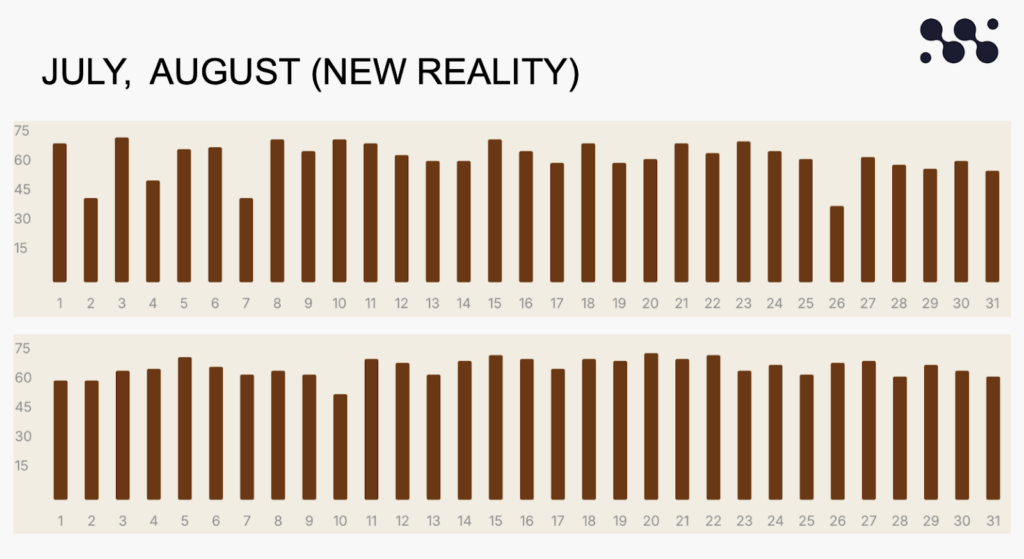
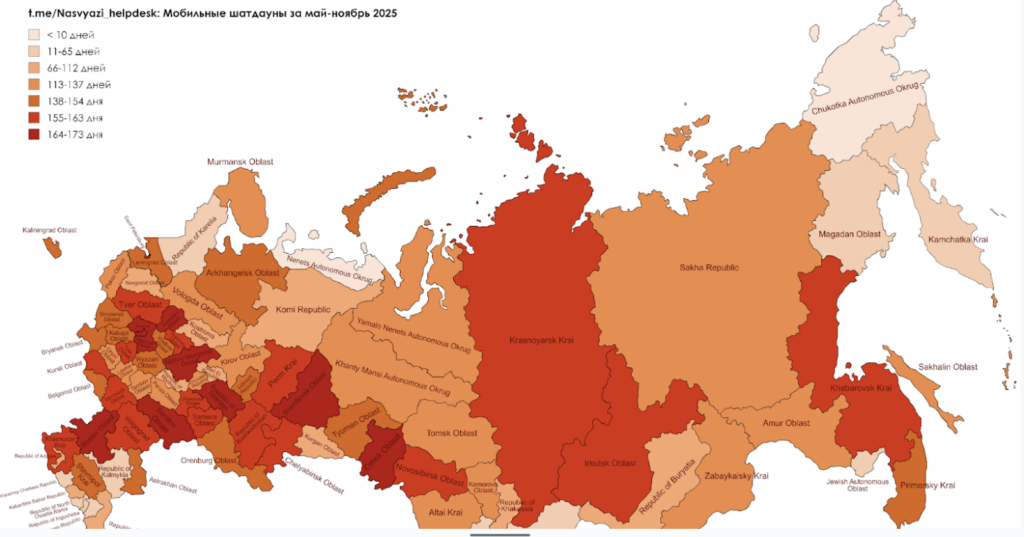
Map of mobile connectivity shutdowns May-November 2025; source: RuNet Monitor
The data on the RuNet Monitor is mainly composed from first-hand accounts of Russian citizens who report shutdowns using either the form on the website or the Telegram bot. Of course, this data has yet to be correlated with network monitoring from sources such as IODA, OONI or Kentik. However, Na Svyazi verifies each report before counting it as a valid one. This methodology has its limitations, for instance, the regions with the least amount of shutdowns are also the most remote and with lower digital literacy levels, which could explain lower rate of reports coming from those areas. However, the volume of aggregated reports is impressive and definitely shows trends in technologies and methods of Runet control.
Another part of this strategy, similar to Iran, is the whitelist approach. Indeed, whitelists are actively spreading to specific regions, where the “antimessenger mode” is introduced, either in response to hypothetical drone attacks or to local unrest. Under a whitelist, people can only get access to a defined set of digital services. The whitelist varies slightly by region. Currently, this list counts around 70 resources, including specific banking services, mobile internet providers, social networks (Vk.com, Ok.ru), mail services (mail.ru, yandex.ru), governmental websites and administrative services, mapping services, marketplaces.
However, vital services such as the mobile app from the Ministry of Emergency Situtations which alerts about air raids, are not included in the whitelist. On July 1, 2025 in the city of Izhevsk 35 people were injured and 3 people died in a drone attack on the electromechanical factory “Kupol”. None of them has received alerts about the air raid. Besides, other vital services such as continuous glucose monitoring (CGM) sensors, stop working under the whitelists. CGM sensors alert patients to high or low blood sugar levels, helping to prevent hypoglycemia—a critical drop in blood glucose that can lead to coma or even death. Parents of children with diabetes use the system to remotely monitor their child’s blood glucose levels while they are at nursery or school. During internet shutdowns, such medical applications become unavailable,
If parents do not find out about their child’s drop in blood glucose levels in time, they cannot take measures to regulate their sugar levels.
The justifications for blocking services such as “protecting citizens”, “preventing drone attacks”, and “maintaining safety” — serve to normalize the loss of internet freedom. These actions lead to a societal shift where people, under continuous restrictions, grow more insecure and more inclined toward authoritarian governance as a perceived stabilizing force. Over 1.2 million websites, 258 VPN services, and 252 anonymous email services were blocked in 2025. Popular messengers like Telegram and WhatsApp have also faced consistent blocking efforts.
The review offers insights into how Russian citizens and tech-savvy users adapt by using sophisticated tools to bypass blocks. Circumvention tools like OpenVPN and WireGuard face high levels of blocking, but more resilient methods, such as V2Ray and TOR, show growing popularity for evading government monitoring.
The narrative of escalating restrictions, with increasingly pervasive censorship, exemplifies a deeper fragmentation within the internet, as Russia’s digital infrastructure isolates itself further from the global network. The presentation underscores the challenges ahead for those resisting censorship and for those trying to maintain some level of unrestricted internet access.
These developments point to a larger trend of internet fragmentation, where state actors use legislative and technological methods to control digital access, undermining global connectivity and freedom.
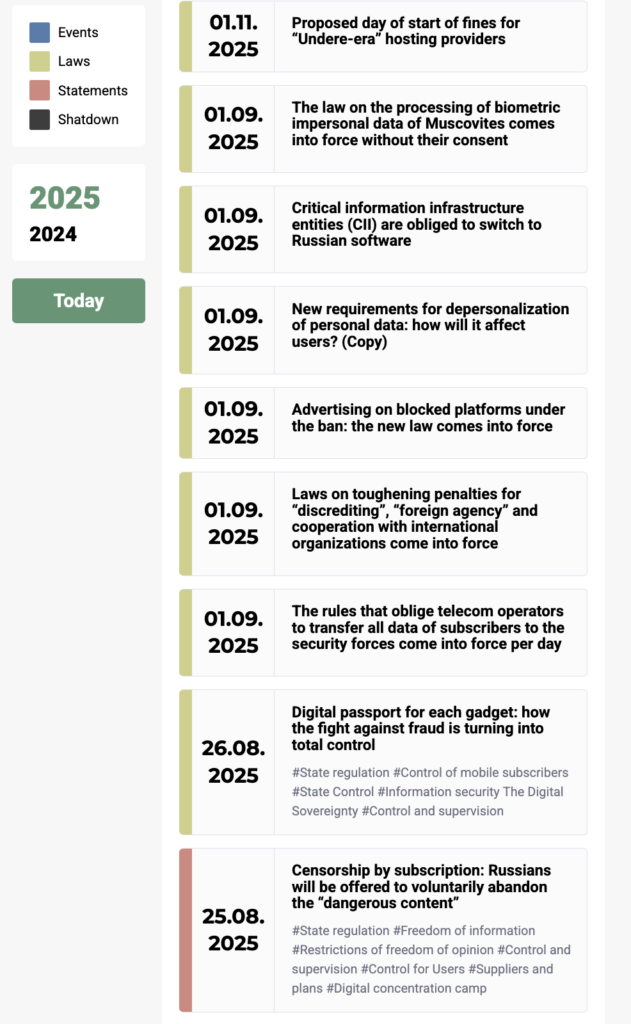
Screenshot from Runet Timeline.